A hiking trip to Hamilton's bridge
Join me in a literary pilgrimage to the pinnacle of mathematical vandalism. A tale of imagination, complexity and algebra, with a handful of unexpected digressions.
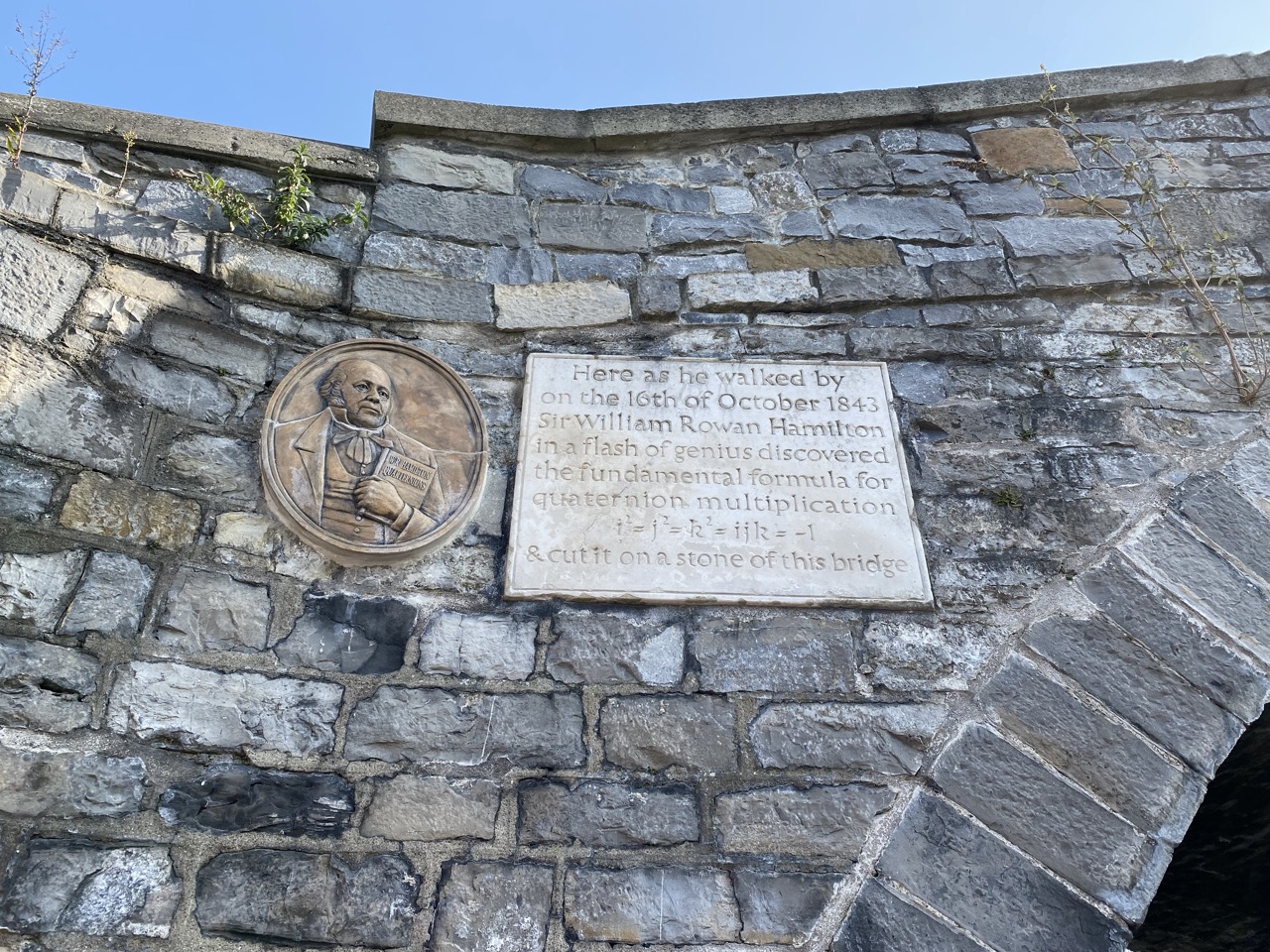
On the 16th of October 1843, history was made. As the Irish mathematician William Rowan Hamilton walked along the Royal Canal headed to a meeting of the Royal Irish Academy, he found the answer to a problem that he had been working on for months. Filled with excitement and in an act of mathematical vandalism, he engraved his answer on a nearby bridge.
What problem was Hamilton working on? What does all of this have to do with a hiking trip? Let me explain.
The expedition
For now, let us forget about the nineteenth century and go closer to the present. Back in March 2022, I was a student at Maynooth University. I had already been in Ireland for a few months and, out of curiosity, I went online to look up information about Hamilton. Very much to my surprise, I discovered that I had already been to the bridge on which Hamilton unleashed his creativity. And I had not been there just once or twice, but dozens of times! As it turns out, the commuter train connecting Maynooth and Dublin goes right under the bridge, and one seemingly irrelevant station on the line is right next to it and bears its name: Broombridge.
When I learnt this, I felt a mix of excitement and shame. How could I have been ignoring such an important landmark all this time? Many years ago, I chose to write an essay about Hamilton's life and work for one of my first college assignments. I had heard of Hamilton's bridge for ages. And yet, I failed to recognise it when I had it in front of my own eyes. What can I say? The fault was on me. Dishonour on me. Dishonour on my cow.
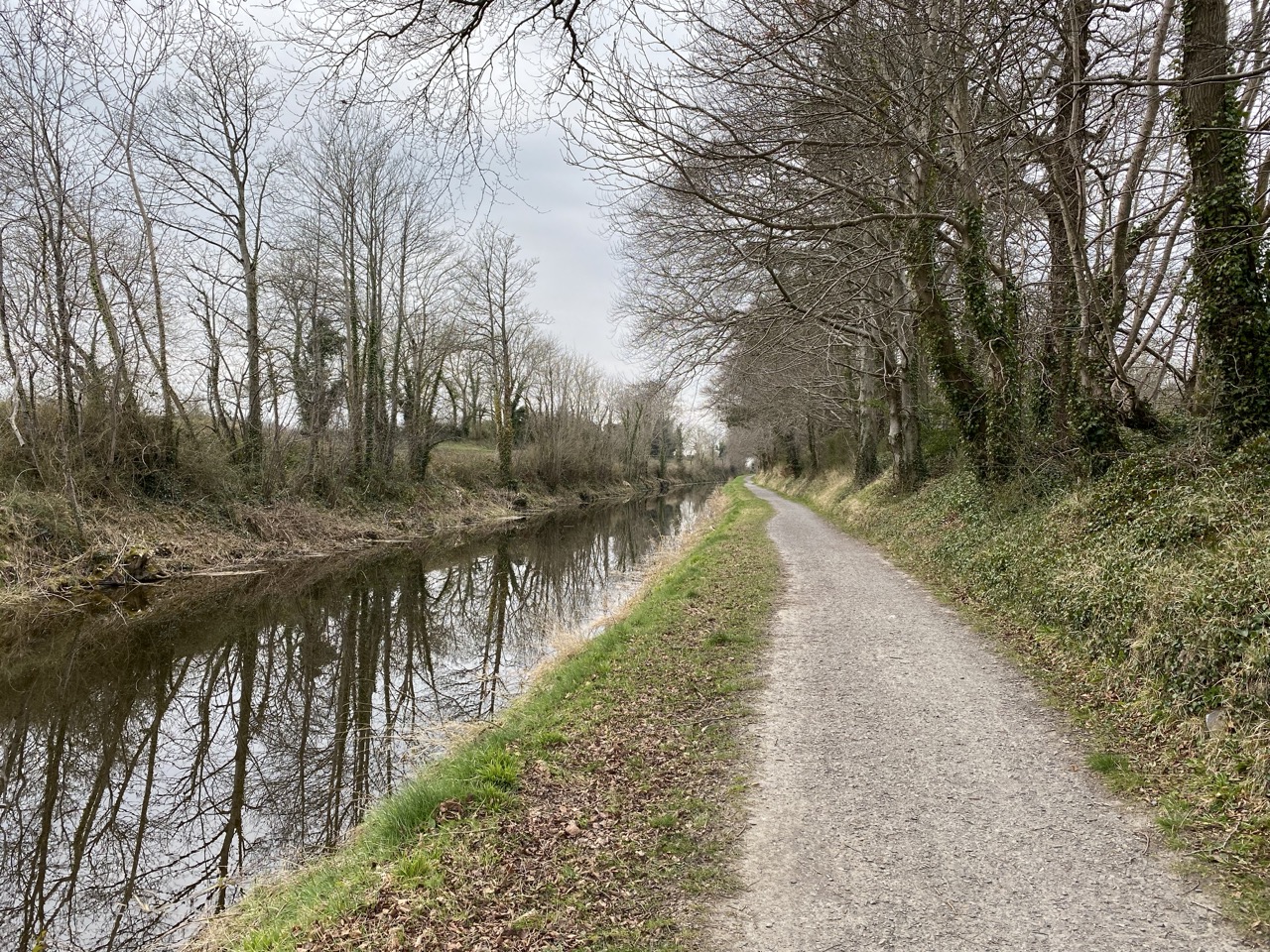
There was only one way to restore my pride as a mathematician: walk my way to Broombridge. Luckily for me, the very same Royal Canal footpath that Hamilton was walking on when he made his discovery goes through Maynooth. And, thus, the decision was made. On the 20th of March, I woke up early in the morning, packed some lunch, and set out to follow in Hamilton's footsteps.
The pathway is absolutely gorgeous. I can't recommend it enough. It's in no way monotonous: it goes through a few small towns, but you are surrounded by nature most of the time with a healthy amount of variety in the landscape. Of course, it's beautiful and green as you would expect anywhere in Ireland. Moreover, the train tracks run parallel to the path and there are plenty of stations along the way, which can be convenient should any problems arise.

The journey to Broombridge was lovely. It took me about four hours to get there, so I had plenty of time to think about all sorts of things: some more mundane, some intellectual and some more spiritual. But we are not here to discuss the thoughts of my 2022 self; we are here to talk about Hamilton, his discovery and his bridge. Hence let us now discuss what kind of problem sparked in Hamilton that historic burst of creativity.
Associative real division algebras
If we want to understand, from a modern perspective, the problem that Hamilton was trying to solve, we first need to introduce a few notions from abstract algebra; so get ready for some definitions. I assume that you are familiar with vector spaces, fields, (division) rings and their associated notions, such as those of their iso-, mono- and homomorphisms. If you are not, a quick internet search might be enough to get you up to speed.
An algebra over a field \(K\) is a \(K\)-vector space \((V, +, \cdot )\) together with an associative binary operation \(\ast : V \times V \longrightarrow V\) that is \(K\)-bilinear; we refer to this operation as the multiplication operation of the algebra. Some authors do not require multiplication to be associative and hence make a distinction between "algebras" and "associative algebras", but we will not.
Algebras over the field of the real numbers are usually called real algebras. Furthermore, an algebra is said to be unital if its multiplication has an identity element, and it is said to be a division algebra if every non-zero vector has a multiplicative inverse. We should highlight that a \(K\)-vector space \((V,+,\cdot )\) with a multiplication operation \(\ast \) forms a division algebra if and only if \((V, +, \ast )\) is a division ring and \(\ast \) is \(K\)-bilinear.
As exotic as these structures may appear to be, there is a high chance that you have already encountered them in the mathematical wilderness. Let me give you a couple of examples.
Let's begin with something familiar. You have almost certainly multiplied matrices at some point in your life. Well, the vector space of square matrices (of a given dimension) over some field \(K\) together with matrix multiplication is a unital algebra over \(K\). Same goes for the space of endomorphisms of a vector space with the operation of composition.
And now the crème de la crème. The real vector space of the complex numbers together with complex multiplication is a real division algebra.
Now how do these notions relate to the problem that William Hamilton was trying to solve back in 1843? Hamilton didn't think in terms of vector spaces and algebras, but, up to translation to our modern vocabulary, he wanted to find a three-dimensional real division algebra analogous to the two-dimensional algebra of the complex numbers. He began by extending the complex numbers to three dimensions introducing a new imaginary constant \(j\neq i\) such that \(j^{2} = -1\), and he realised that addition and scalar multiplication could be trivially defined, just as for the complex numbers, as the component-wise addition and scalar multiplication. In this way, a pair of these "three-dimensional complex numbers" would be added as \[(a + b i + c j) + (x + y i + z j) = (a + x) + (b + y)i + (c + z)j, \] whereas multiplication by scalars would work as \[\lambda \cdot (a + b i + c j) = (\lambda a) + (\lambda b) i + (\lambda c) j. \] This actually defines a real vector space and Hamilton found nothing problematic with these operations. However, there was a missing piece in the puzzle. He couldn't find a way to introduce a multiplication operation that would give rise to a division algebra for this vector space.
After struggling with this problem for months, Hamilton found a surprising solution: going beyond three dimensions. He realised that, by adding two extra imaginary constants to the complex numbers rather than just one, he would be able to define a division algebra! He denoted these extra imaginary constants as \(j\) and \(k\) and he took multiplication to be the only associative bilinear operation such that \[i^{2} = j^{2} = k^{2} = i j k = -1. \] This multiplication, together with the component-wise addition and scalar multiplication that we discussed before, defines a four-dimensional division algebra, as you can easily check by yourself. The algebra is known as the algebra of quaternions and, in honour of Hamilton, is usually denoted as \(\mathbb{H}\).
The formula that characterises the multiplication of quaternions is the one that Hamilton engraved onto Broombridge, right after the flash of genius that led him to its discovery.
The Frobenius theorem
A question still remains. Is it possible to define a three-dimensional division algebra over the real numbers? Thanks to Frobenius' theorem, we know that it is not. According to it, all finite-dimensional real division algebras must be isomorphic to either the real numbers, the complex numbers or the quaternions.
Eager for a proof? You have it. But, first, we should take a brief detour.
So, what's a polynomial?
Given any commutative ring \(R\) and a formal symbol \(X\), the polynomial ring \(R[X]\) of \(R\) in the variable \(X\) is the set of all formal constructions of the form \[a_{n} X^{n} + \cdots + a_{1}X + a_{0} \] where \(n\) is a non-negative integer and \(a_{i} \in R\) for every index \(i\). Addition and multiplication within \(R[X]\) are defined as the usual addition and multiplication of polynomials, relying on the operations of \(R\) for the coefficients; with these operations, \(R[X]\) is a commutative ring.
Every polynomial has an associated evaluation function. If \(p\in R[X]\), its evaluation function \(p_{e} : R \longrightarrow R\) takes any \(a \in R\) to the result of replacing every instance of \(X\) in \(p\) by \(a\), using the operations of \(R\). Since we mathematicians are lazy, we use the same symbol to denote polynomials and their evaluation functions. Thus, for example, \[p \coloneqq X^{2} + X + 1 \in R[X] \implies p(a) = a^{2} + a + 1 \in R. \]
Nevertheless, our options don't end there! Consider a ring monomorphism \(\theta : R \longrightarrow S\) into a (possibly non-commutative) ring \(S\). Every \(p \in R[X]\) does induce an evaluation function \(S \longrightarrow S\) defined, for any \(s \in S\), as the result of replacing every instance of \(X\) in \(p\) by \(s\) and every coefficient \(a_{i}\) by \(\theta (a_{i})\), using the operations of \(S\). For example, given any such \(s\) and an \(a \in R\), \[p \coloneqq a X^{2} + X\in R[X] \implies p(s) = \theta (a)\cdot s^{2} + s \in S. \] Furthermore, if \(s\) belongs to the centraliser \(C_{S}(\theta (R))\) of \(\theta (R)\) in \(S\), then the function \[p \in R[X] \longmapsto p(s) \in S \] is a ring homomorphism (from \(R[X]\) to \(S\)). This means that, given any pair of polynomials \(p,q \in R[X]\), \[(p + q)(s) = p(s) + q(s) \in S,\qquad (p\cdot q)(s) = p(s) \cdot q(s).\] I think that you can prove this yourself, but keep in mind that — at least for the preservation of multiplication — we need to have \(s \in C_{S}(\theta (R))\). Indeed, suppose that \(s\) does not commute with \(\theta (r)\) for some \(r \in R\), and take \(p = X\) and \(q = r\). Then \(p q = r X\), so \((p q)(s) = \theta (r) s\), whereas \(p(s) q(s) = s \theta (r)\).
This whole business of evaluating polynomials in other rings via some homomorphisms may seem strange. Perhaps a few examples will prove illustrative.
Given a unital algebra \(A\) over a field \(K\), the set \(A\) with addition and the algebra's multiplication is a ring. If \(p \in K[X]\) and \(a \in A\), we can always evaluate \(p(a)\) via the monomorphism \(x \in K \mapsto x 1 \in A\). Moreover, since any scalar multiple of \(1\) commutes with all the elements in the algebra, \(p \in K[X] \mapsto p(a) \in A\) is a ring homomorphism for every element \(a\in A\).
Continuing with the previous example, if the algebra \(A\) contains a copy of some ring \(R\), defined via a ring monomorphism \(R \longrightarrow A\), then we can use this monomorphism to evaluate any \(p \in R[X]\) at an \(a \in A\). Moreover, if some \(a\) commutes with all the elements in \(R\), the evaluation \(p \mapsto p(a)\) will be a ring homomorphism.
That's enough for our brief interlude and we can go back to the proof of the Frobenius theorem. Make sure you understand these two examples that we have discussed, because we will use them later.
Back to Frobenius
Let \(A\) be a finite-dimensional division algebra over the real numbers. For simplicity, we will use multiplicative notation to denote both multiplication by scalars and the algebra's multiplication operation. If the dimension of (the vector space of) \(A\) is one, then, clearly, \(A\) is isomorphic to the real numbers. Let us then assume that the dimension of \(A\) is strictly bigger than one. We shall begin by proving that there must exist an element \(i \in A\) such that \(i^{2} = -1\). To this end, we will consider the subspace \(R\) spanned by the unit \(1 \in A\). Clearly, \(R\) is isomorphic to \(\mathbb{R}\).
We will now pick an arbitrary element \(a \in A \setminus R\). Since we have assumed \(A\) to be finite-dimensional, there has to exist a natural number \(k\) for which the family \(\{1 = a^{0}, a^{1},\ldots ,a^{k}\}\) will be linearly dependent and \(\{1, \ldots ,a^{k-1}\}\) will not. Under these conditions, there must exist some scalars \(\lambda _{0},\ldots ,\lambda _{k}\) such that \[\lambda _{k} a^{k} + \cdots + \lambda _{1} a^{1} + \lambda _{0} 1 = 0,\] with \(\lambda _{k} \neq 0\), for otherwise \(\{1, \ldots , a^{k-1}\}\) would be linearly dependent. Let us define the real polynomial \[\mu (x) \coloneqq x^{k} + \frac{\lambda _{k-1}}{\lambda _{k}} x^{k-1} + \cdots + \frac{\lambda _{0}}{\lambda _{k}}.\] This polynomial is said to be the minimal polynomial of \(a\) and, clearly, \(\mu (a) = 0\).
The polynomial \(\mu \) must be irreducible, as we will now show by contradiction. Were \(\mu \) reducible, there would exist two non-constant and non-zero polynomials \(p\) and \(q\) such that \(\mu = p q\). Therefore, \(\mu (a) = p(a) q(a) = 0\). Since there can be no zero divisors in a division algebra (prove it if in doubt!) this means that either \(p(a) = 0\) or \(q(a) = 0\); we will assume the former. Let \(r\) be the degree of \(p\). If \(p(a) = 0\), then the family \(\{1, a^{1}, \ldots , a^{r}\}\) must be linearly dependent. But \(r < k\) and \(\{1,\ldots ,a^{k-1}\}\) is linearly independent, which is a contradiction. In conclusion, \(\mu \) is irreducible!
All irreducible polynomials over the real numbers have degree one or two. This follows by noticing that the complex numbers are algebraically closed and that, for every real polynomial \(p\) and any complex \(x\), we have \(p(x^{\ast }) = p(x)^{\ast }\), where the asterisk denotes complex conjugation. Therefore, \(\mu \) has degree either one or two. If \(\mu \) had degree one, then \(a\) would belong to \(R\), but we are assuming this not to be the case, hence \[\mu (x) = x^{2} + \beta x + \gamma \implies a^{2} + \beta a + \gamma 1 = 0, \] for some real \(\beta \) and \(\gamma \) such that \(\beta ^{2} - 4\gamma < 0\), in order for \(\mu \) to be irreducible. With this, if we set \[i \coloneqq \frac{2}{\sqrt{4\gamma - \beta ^{2}}}a + \frac{\beta }{\sqrt{4\gamma - \beta ^{2}}}1 \in A,\] it is easy to check that \(i^{2} = -1\). We can hence consider the subalgebra \(C = R + R i \subseteq A\), which will be isomorphic to the algebra of the complex numbers.
Given any \(a\in A\), take its minimal polynomial \(\mu \), which, since the complex numbers are algebraically closed, must be of the form \[\mu (x) = (x - \lambda _{1}) \cdots (x - \lambda _{n})\] for some complex numbers \(\lambda _{i}\). Moreover, if \(a\) commutes with \(i\) and, therefore, with all of \(C\), the function \(p \in \mathbb{C}[X] \mapsto p(a) \in A\) is a ring homomorphism, hence \[\mu (a) = (a - \lambda _{1}\cdot 1)\cdots (a - \lambda _{n}\cdot 1) = 0. \] Since \(A\) has no zero divisors, this must mean that, for some \(\lambda _{i} \in \mathbb{C}\), \(a = \lambda _{i} \cdot 1 \in C\).
This shows that, if all the elements in \(A\) commute with \(i\), then \(A = C\), hence \(A\) must be isomorphic to the complex numbers. Thus, we only have one case left to consider. From now on, let's assume that not every element in \(A\) commutes with \(i\).
The set \(A\) with addition and multiplication by scalars is a real vector space. However, we can also see it as a complex vector space if we extend multiplication by scalars, for any real \(r,t\) and any \(a\in A\), as \[(r + t i)a \coloneqq r a + t(i \cdot a).\]
Consider the map \(I\) taking any \(a\in A\) to \((a \cdot i) \in A\). Regarding \(A\) as a complex vector space, it is easy to check that \(I\) is \(\mathbb{C}\)-linear. Moreover, given any \(a \in A\), \[a = \underbrace{\frac{a - i a i}{2}}_{a_{+}} + \underbrace{\frac{a + i a i}{2}}_{a_{-}},\] where — as you can easily check for yourself — \(a_{+}\) is an eigenvector of \(I\) with eigenvalue \(+i\) and \(a_{-}\) is an eigenvector of \(I\) with eigenvalue \(-i\). Leveraging this observation, we know that \(A\) is the direct sum of two eigenspaces of \(I\): one for the eigenvalue \(i\), and one for the eigenvalue \(-i\). Symbolically, \[A = S(i) \oplus S(-i), \] where we are using \(S(-)\) to denote the eigenspaces of \(I\).
Incidentally, there is a more natural way of showing that \(A\) is a sum of eigenspaces of \(I\) if you consider the minimal polynomial of \(I\). If you are curious and don't know what the minimal polynomial of an endomorphism is, I invite you to read Gorodentsev's Algebra I. Proposition 15.6 is what you should be aiming for. Anyway, I don't want to get too diverted — back to our proof!
The eigenspace \(S(i)\) is the set of elements \(a \in A\) such that \(a i = i a\). Therefore, according to our previous discussion, \(S(i) = C\). On the other hand, \(S(-i)\) is the set of elements \(a \in A\) such that \(a i = -i a\). We don't know much about this space yet, but we can deduce a few properties. Firstly, it is clear that if \(a\neq 0\) belongs to \(S(-i)\), so does its inverse \(a^{-1}\): if \(a i = -i a\), then \[(a i)^{-1} = -i a^{-1} = a^{-1}i = (-i a)^{-1}.\] In addition, given any pair of elements \(x,y \in S(-i)\), their product must belong to \(C\) for \(x y i = -x i y = i x y\), and, as we have mentioned on plenty of occasions, an element belongs to \(C\) if and only if it commutes with \(i\). It then follows that, for any non-zero \(x \in S(-i)\), we have \(S(-i) = C x\).
Now take a non-zero \(x \in S(-i)\). We know that \(x^{2} \in C\), but there's more. Clearly, \(x^{2}\) commutes with \(x\); therefore, since \(i\) does not commute with \(x\) and every element in \(R\) does, \(x^{2}\) must belong to \(R\). To see this, assume that \(x^{2} = \alpha 1 + \beta i\). We have \begin{align*} x^{2} x = x^{3} = x x^{2} & \implies (\alpha + i \beta ) x = x (\alpha + i \beta ) \\ & \implies \beta (x i - i x) = 0, \end{align*} which, since \(i x \neq x i\) and since there are no zero divisors in \(A\), means that \(\beta = 0\). In addition to this, \(x^{2}\) must be smaller than zero. Were this not the case, there would exist a real square root of \(x^{2}\): an \(r \in R\) such that \(r^{2} = x^{2}\). As \(x\) is a root of the polynomial \[p(X) \coloneqq X^{2} - x^{2} = (X + r) (X - r) \] and real numbers commute with all the elements in \(A\), we would have \[p(x) = (x + r)(x-r) = 0, \] hence this would lead us to \(x \in R\), yet the intersection of \(R\) with \(S(-i)\) is \(\{0\}\).
Thus, fix any non-zero \(x \in S(-i)\) and set \(j \coloneqq x/(\sqrt{-x^{2}})\). Clearly, \(j^{2} = -1\). Moreover, as we mentioned before, \(A = C \oplus C j\). Since \(C j\) is spanned by \(j\) and \(i j\), if we fix \(k \coloneqq i j\), the family \(\{1, i, j, k\}\) will be a basis of \(A\). Moreover, it follows trivially that \[i^{2} = j^{2} = k^{2} = i j k = -1. \] We may hence conclude that \(A\) is isomorphic to the algebra of quaternions.
Wrapping up
In summary, the proof has gone as follows:
If the dimension of the algebra is one, then it is isomorphic to the real numbers.
If the dimension of the algebra is bigger than one, then we can always construct the constant \(i\) that we introduced in the proof. If all the elements in the algebra commute with \(i\), then the algebra is isomorphic to the complex numbers.
Lastly, if not every element in the algebra commutes with \(i\), then the algebra must be isomorphic to Hamilton's quaternions.
And that's the proof!
Epilogue
Once I arrived in Broombridge, I took a few pictures and walked around the place. I had my packed lunch on a bench at the Broombridge train station and, after a quick rest, I set off back to Maynooth. As I walked, the reddish light of the late afternoon began to fill the landscape with warmer tones, but it didn't take too long for some clouds to darken the experience.
I made it home well in time for dinner. When I was about to enter my apartment, I met one of my flatmates, who greeted me with a simple "how are you?". To this I replied — with genuine excitement and without providing any context — "Great! I have been to Broombridge!!". He probably didn't understand the significance of this event, but you and I do. That was the end of a hiking trip that I will always dearly remember.
What else?
In this post, we've learnt a little bit about Hamilton's best-known mathematical achievement. If you'd like to learn more about his life and work, you should watch this video by Kathy Joseph.
If you ever visit Dublin, you can get to Broombridge from the city centre by taking the Luas. Also, if you live in Ireland, you might be able to participate in the yearly Hamilton Walk that is held every 16th of October.
To conclude, I would just like to make a bibliographical remark. My two primary references for the proof of the Frobenius theorem have been the book Basic structures of modern algebra by Yuri Bahturin, and some notes by Michael Barr in which a proof by Peter Freyd is presented. Both sources are worth reading if you have the time.
- Published